What Is ELA? ELA vs ESL, and Why Your Child Should Learn English the ELA Way
American students don't “learn English” — they study English Language Arts: reading whole books, writing with reasons, discussing and presenting. Here is ELA in plain language, with the research behind it and what it means for children in Vietnam.
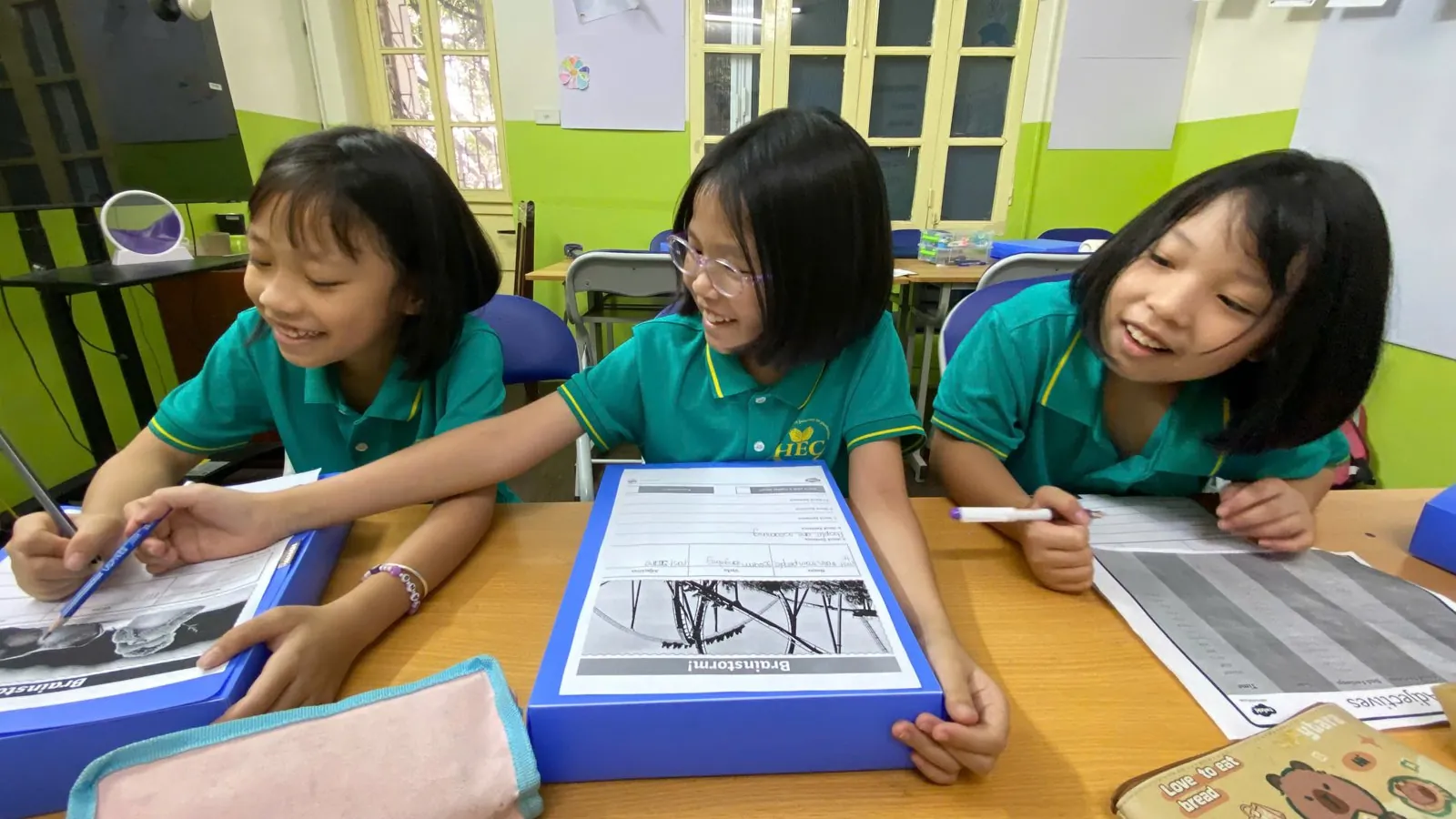
- ELA (English Language Arts) is the English subject in American schools: reading, writing, speaking and listening, and language, usually following the Common Core.
- ESL (English as a Second Language) teaches English as a foreign language: topic vocabulary, grammar and conversation patterns.
- The core difference: ESL teaches children about English; ELA teaches them to use English to understand, think and explain.
- Research favors using language over memorizing it: writing about texts deepens comprehension, using new words in writing helps them stick, and learning English through content beats regular English lessons.
- HEC teaches the ELA way, aligned to the Common Core and following Cambridge levels (which match the CEFR); no more than 12 students per class; 210,000 VND per 90-minute session.
In this guide
What is ELA?
ELA stands for English Language Arts — the English subject American students study from kindergarten to Grade 12, much like Ngữ văn (Vietnamese literature and language) for Vietnamese students. Most US states teach ELA to the Common Core State Standards or to their own standards built on the same lines. The standards have four strands:
- Reading: literature (stories, poems, drama) and informational text (science, history, social studies). In primary school this includes foundational skills such as phonics and fluency.
- Writing: three main types — opinion/argument, informative/explanatory and narrative — plus research and using evidence.
- Speaking & Listening: group discussion, asking questions, presenting and responding with evidence.
- Language: grammar, spelling and vocabulary — learned in context through reading and writing, not as separate drills.
In short, ELA does not treat English as something to memorize. It treats it as a tool for understanding, thinking and communicating.
Some US school districts also use “ELA” for English Language Acquisition, their support program for English learners. In this guide and at HEC, ELA always means English Language Arts.
What is ESL?
ESL (English as a Second Language) is English taught to people whose first language is something else. In Vietnam, this model (strictly speaking EFL, English as a foreign language) is how most English classes work: topics such as family, school or hobbies, each lesson with a word list, one grammar structure and a few dialogue patterns.
ESL has its place: beginners do need sounds, letters and basic sentence patterns. The trouble is that many classes stop there. Children memorize words, get the grammar exercises right and can hold a simple conversation — then struggle when asked to read a long text, write a paragraph with their own opinion or present to the class.
ELA vs ESL: the differences
| Aspect | ESL (English as a foreign language) | ELA (English Language Arts) |
|---|---|---|
| Goal | Everyday conversation; memorize words and structures | Use English to understand, think, write and present |
| Content | Topic units, model dialogues | Stories, science and social studies texts, whole books |
| Vocabulary | Word lists per unit, memorized | Learned from reading, reused in speaking and writing |
| Grammar | Rules and gap-fill exercises | Learned to write and speak more accurately; corrected on the child's own work |
| Writing | Single sentences, fill in the blanks | Paragraphs and multi-paragraph pieces in different genres |
| Speaking | Repeating patterns | Discussion, debate, presentations with evidence |
| Assessment | Vocabulary and grammar tests | Rubrics for writing, speaking and projects |
| Standards | Depends on the textbook | Common Core ELA (USA) |
← Swipe to see the whole table →
The table describes two typical models; many real classes mix the two to different degrees.
One example: the same topic, two ways to teach it
Learn 10 new words (camel, desert, survive…), practice “What's this? It's a camel.”, do a matching exercise and a gap-fill. Copy the words out at home.
Read a science text about how animals adapt, discuss “How can camels survive in the desert?”, write an explanatory paragraph with a topic sentence and two pieces of evidence from the text, then present it to the class.
Both classes learn camel, desert, survive. Only in the second do children have to use those words to think, explain and persuade — and that is what makes the difference.
7 research findings: why using English beats memorizing it
The ELA approach isn't just a teaching style. It rests on findings about how people learn languages that have been tested again and again.
1. Fluent conversation is not academic English
Linguist Jim Cummins distinguished two kinds of proficiency: BICS, everyday conversational skills, and CALP, academic language proficiency. In his framework, second-language learners typically reach everyday fluency in about 1–2 years but need 5–7 years to match native-speaking peers in academic English. A child who chats easily in English can still struggle with a science text or an opinion paragraph — they are different abilities. ELA builds the second one from the start.
2. Meeting a word 10 times doesn't mean you can use it
In Stuart Webb's 2007 study of 121 learners of English in Japan, learners met new words 1, 3, 7 or 10 times in context. More encounters meant more word knowledge — but even after 10 encounters, learners were clearly better at recognizing the words than at using them. Seeing and memorizing builds recognition; to use a word, children have to say it and write it.
3. Writing with new words makes them stick
Hulstijn and Laufer (2001) compared vocabulary tasks with different levels of “involvement”: reading with glossed words, reading plus a gap-fill, and writing a short composition using the new words. Under the Involvement Load Hypothesis they tested, tasks that make learners need a word, search for its meaning and weigh how to use it — as in writing your own text — lead to better retention than simply reading the meaning. That's why every ELA lesson ends with something the child produces: a paragraph, a talk, a project.
4. Writing about reading improves reading
The Carnegie Corporation report Writing to Read by Steve Graham and Michael Hebert (2010) reviewed experimental studies from Grade 1 to Grade 12 and concluded that having students write about what they read — summaries, notes, answering and asking questions, extended responses — improves their comprehension, and that teaching writing also improves reading comprehension and fluency. In ELA, reading and writing always go together.
5. Lots of stories: progress at about twice the normal rate
Warwick Elley and Francis Mangubhai's “Book Flood” study (1983) followed 380 Grade 4–5 students learning English as a second language in Fiji for about eight and a half months. Classes “flooded” with illustrated storybooks — wide reading, teachers reading aloud and sharing the stories — gained in reading and listening comprehension at about twice the normal rate, and the advantage kept growing in later assessments. ELA puts reading real texts at the center.
6. Learning English through content beats regular English lessons
A meta-analysis by Lee, Lee and Lo (2023) combined 38 studies of 7,434 secondary students learning English through subject content (CLIL/EMI) against students in regular English classes. The content group reached clearly higher English proficiency: effect sizes of d = 0.73 in the short term and d = 1.01 in the longer term — medium-to-large and large by the usual statistical yardstick. An ELA class, where children learn English through literature, science and social studies, works on exactly this principle.
7. Let children talk more: about six months of extra progress
The Education Endowment Foundation's Teaching and Learning Toolkit (UK) rates oral language approaches — discussion, structured dialogue, presenting — at about +6 months of additional progress a year, at very low cost. Notably, sessions led by trained teaching assistants showed about the same impact as those led by teachers. That's why HEC classes pair the teacher with teaching assistants: more small groups talk and get corrected at the same time.
| Research | Key finding | What it means in class |
|---|---|---|
| Cummins (BICS/CALP) | Conversation: 1–2 years; academic: 5–7 years | Don't stop at “can speak”; build academic English early |
| Webb (2007) | 10 encounters still aren't enough to use a word | New words must be spoken and written, not just memorized |
| Hulstijn & Laufer (2001) | More involving tasks, better retention | Every lesson ends with the child's own work |
| Graham & Hebert (2010) | Writing about texts improves comprehension | Reading and writing always go together |
| Elley & Mangubhai (1983) | Lots of stories: about twice the progress | Real texts, and plenty of them |
| Lee, Lee & Lo (2023) | Content-based learning: d = 0.73 → 1.01 | Learn English through literature, science, social studies |
| EEF Toolkit | Oral language work: about +6 months | Small classes, teaching assistants, lots of talk |
← Swipe to see the whole table →
- Your child needs to read real texts — stories, science articles — not just model dialogues.
- Your child needs to speak and write with new words, not just copy and memorize lists.
- Your child needs feedback on their own work — which only happens when the class is small enough.
Does ELA work for children in Vietnam?
ELA was designed for American students, but some programs are built specifically to bring English learners up to grade-level texts. National Geographic Reach Higher — the textbook in HEC's Jupiter class — is a six-level primary program that combines original fiction with National Geographic science and social studies content, building vocabulary, phonics, reading, writing and speaking for academic English. Its authors include researchers in the education of bilingual learners such as Professor Nonie K. Lesaux (Harvard University) and Dr. Deborah J. Short, co-developer of the SIOP teaching model.
Policy is moving the same way. Under Decision 2371/QĐ-TTg (October 27, 2025), Vietnam aims to make English a second language in schools. A second language is a language you learn in, not just one you greet people in — and that is what ELA trains.
Three conditions make ELA work for Vietnamese children:
- Group by level, not by age. Beginners still learn sounds, letters and basic patterns, but through read-alouds, storytelling and sentence writing rather than memorization alone.
- Small classes. ELA requires the teacher to read and correct every piece of writing and hear every talk. A class of 25 can't do that every session.
- Support in Vietnamese when needed. A Vietnamese teaching assistant helps children understand difficult tasks, so class time goes on using English.
ELA and exams: Cambridge, Grade 6 entrance, IELTS
ELA is not test drilling. But what ELA trains — reading long texts, writing organized paragraphs, speaking with reasons — is exactly what exams score.
- Cambridge qualifications: Pre A1 Starters, A1 Movers, A2 Flyers, A2 Key (KET) and B1 Preliminary (PET) map onto CEFR levels Pre A1 to B1. HEC classes follow these levels.
- Hanoi Grade 6 entrance: for 2026–2027, Cầu Giấy Lower Secondary School admitted students on the total of three assessments in Math, Vietnamese and English; more than 5,500 candidates sat them for 440 places (about 1 in 12.5). Other high-quality schools such as Thanh Xuân and Nam Từ Liêm also use assessment tests. HEC's SKY 1 class prepares Grade 5 students for the English part of these assessments.
- IELTS: academic Reading, Writing Task 2 (argument) and Speaking Parts 2–3 (extended talk and discussion) are ELA skills at a higher level. See IELTS classes in Đống Đa.
- English competitions: school academic contests, IOE and English Olympiads all reward strong language and fast comprehension — both trained every week in an ELA class.
6 questions to spot a real ELA class
“ELA”, “American curriculum” and “academic English” are phrases anyone can use. Ask a center these six questions — and ask to see the evidence.
- Does my child read a whole story or a long text every week, or only short dialogues?
- Does my child write paragraphs and longer pieces in different genres (narrative, explanatory, opinion)?
- Are new words reused in speaking and writing, or only copied and memorized?
- Does my child discuss, debate and present regularly?
- Does the program follow clear standards (Common Core, CEFR, Cambridge) with specific marking criteria?
- Is the class small enough for the teacher to correct every child's writing every week?
HEC answers yes to all six — and invites parents to sit in on a class to check for themselves.
ELA at HEC: from age 4 to Grade 12
Happy English Club (HEC), at No. 25, Alley 242 Láng, Đống Đa, is an English center built on the ELA approach. Children are placed by level after a free placement test, and every level has measurable completion criteria:
- Mars · kindergarten · National Geographic Look Starter
ELA foundations: sounds and letters, read-alouds, retelling stories; decode three-letter words with 90%+ accuracy. - Venus · National Geographic Look 1
Read 70–90 words per minute with 95%+ accuracy; write a 4–6 sentence paragraph. - Neptune · National Geographic Look 2
Write a paragraph with an opening and closing sentence; answer who/what/why questions with evidence. - Jupiter · Grades 3–4, advanced · National Geographic Reach Higher
ELA proper: literature and science texts, 8–10 sentence paragraphs, 2-minute presentations. - SKY 1 · Grades 5–6, advanced · Oxford Discover
Summaries, multi-paragraph reports, 3-minute presentations; Grade 6 entrance and KET/PET preparation. - Sanrio Grade 6 · Grammar & Writing G6
Write 2–3 paragraphs (180–220 words) with a claim and evidence. - Sun · IELTS
Academic English for lower and upper secondary; target band 5.5–7.0.
HEC's Mercury class also teaches Cambridge Math in English — learning language through content, exactly as the research above suggests.
- Licensed by the Hanoi Department of Education and Training.
- Curriculum aligned to the Common Core ELA standards (USA), following Cambridge English levels (matching the CEFR); Oxford and National Geographic textbooks.
- Teacher educated in the USA, with a teaching degree and a New Jersey (USA) teaching certificate.
- Foreign and Vietnamese teaching assistants with degrees in English or education.
- No more than 12 students per class; monthly progress reports; parents welcome to sit in.
- 210,000 VND per 90-minute session, billed only for sessions held; free Saturday Reading Club.
Watch a real ELA lesson: Grade 4 students debate
Not a rehearsed performance — an ordinary lesson. Children take a position, listen to the other side and answer back, entirely in English: the “Speaking & Listening” strand of ELA in real life.
Book a free ELA placement test
A short test, one trial lesson and honest advice about the right level — even if the answer is that your child needs to strengthen the foundations first.
Message Zalo 0975 679 889 Call nowFAQ
What is ELA?
ELA stands for English Language Arts, the English subject American students study from kindergarten to Grade 12. It has four strands: reading (literature and informational text), writing (narrative, informative and opinion), speaking and listening, and language (grammar and vocabulary learned in context), usually following the Common Core standards.
What is the difference between ELA and ESL?
ESL teaches English as a foreign language: topic vocabulary, grammar rules and conversation patterns. ELA teaches students to use English to read real texts, write paragraphs and essays in different genres, discuss and present with evidence. In short, ESL teaches children about English; ELA teaches them to learn and think in English.
Can my child study ELA if their English isn't strong yet?
Yes, as long as classes are grouped by level. At HEC, beginners start in foundation classes (Mars, Venus, Neptune) with sounds and letters, read-alouds and storytelling taught the ELA way; Jupiter (Grades 3–4) and SKY 1 (Grades 5–6) are for students whose English is already strong and who want a greater challenge.
Does ELA help with Cambridge exams, Hanoi's Grade 6 entrance tests and IELTS?
Yes. ELA is not test drilling, but reading long texts, writing organized paragraphs and speaking with reasons are exactly what Cambridge exams (Flyers, KET, PET), Hanoi's Grade 6 entrance assessments with an English paper, and IELTS score. At HEC, the SKY 1 class combines ELA with preparation for these exams.
What is Common Core?
The Common Core State Standards are shared US standards for mathematics and English Language Arts. They set out what students in each grade should be able to read, write, say and understand. Many US states use them directly or as the basis for their own standards.
Where can my child study ELA in Hanoi?
Happy English Club (HEC), No. 25, Alley 242 Láng, Đống Đa Ward, Hanoi, teaches English the ELA way, aligned to the Common Core, from age 4 to Grade 12, with a maximum of 12 students per class. The center is licensed by the Hanoi Department of Education and Training; message Zalo 0975 679 889 to book a free placement test.
How much do ELA classes at HEC cost?
210,000 VND per 90-minute session. Classes meet twice a week, about 1,680,000–1,890,000 VND a month, billed only for sessions actually held, with no hidden fees and currently no book fee.
Sources
- Common Core State Standards Initiative — English Language Arts Standards.
- Cummins, J. — BICS and CALP, summarized by the University of Alberta: Basic Interpersonal Communicative Skills vs. Cognitive Academic Language Proficiency.
- Webb, S. (2007). The effects of repetition on vocabulary knowledge. Applied Linguistics, 28(1), 46–65.
- Hulstijn, J. & Laufer, B. (2001). Some empirical evidence for the Involvement Load Hypothesis in vocabulary acquisition. Language Learning, 51, 539–558.
- Graham, S. & Hebert, M. (2010). Writing to Read: Evidence for how writing can improve reading. Carnegie Corporation of New York.
- Elley, W. B. & Mangubhai, F. (1983). The impact of reading on second language learning. Reading Research Quarterly, 19(1), 53–67.
- Lee, J. H., Lee, H. & Lo, Y. Y. (2023). Effects of EMI-CLIL on secondary-level students' English learning: A multilevel meta-analysis. Studies in Second Language Learning and Teaching, 13(2), 317–345.
- Education Endowment Foundation — Oral language interventions, Teaching and Learning Toolkit.
- National Geographic Learning — Reach Higher program brochure.
- Cambridge English — Pre A1 Starters, A1 Movers, A2 Flyers: Handbook for teachers.
- Tiền Phong — Cầu Giấy Lower Secondary School announces Grade 6 cut-off scores (in Vietnamese, June 2026).
- Thư Viện Pháp Luật — Decision 2371: roadmap to make English a second language in schools (in Vietnamese).