English Classes for Kids in Đống Đa, Hanoi: ELA or ESL, Fees and a Roadmap (2026)
ELA or ESL, class size, teachers, real monthly fees — and the questions that let you check any center yourself before you pay, from kindergarten to Grade 12.
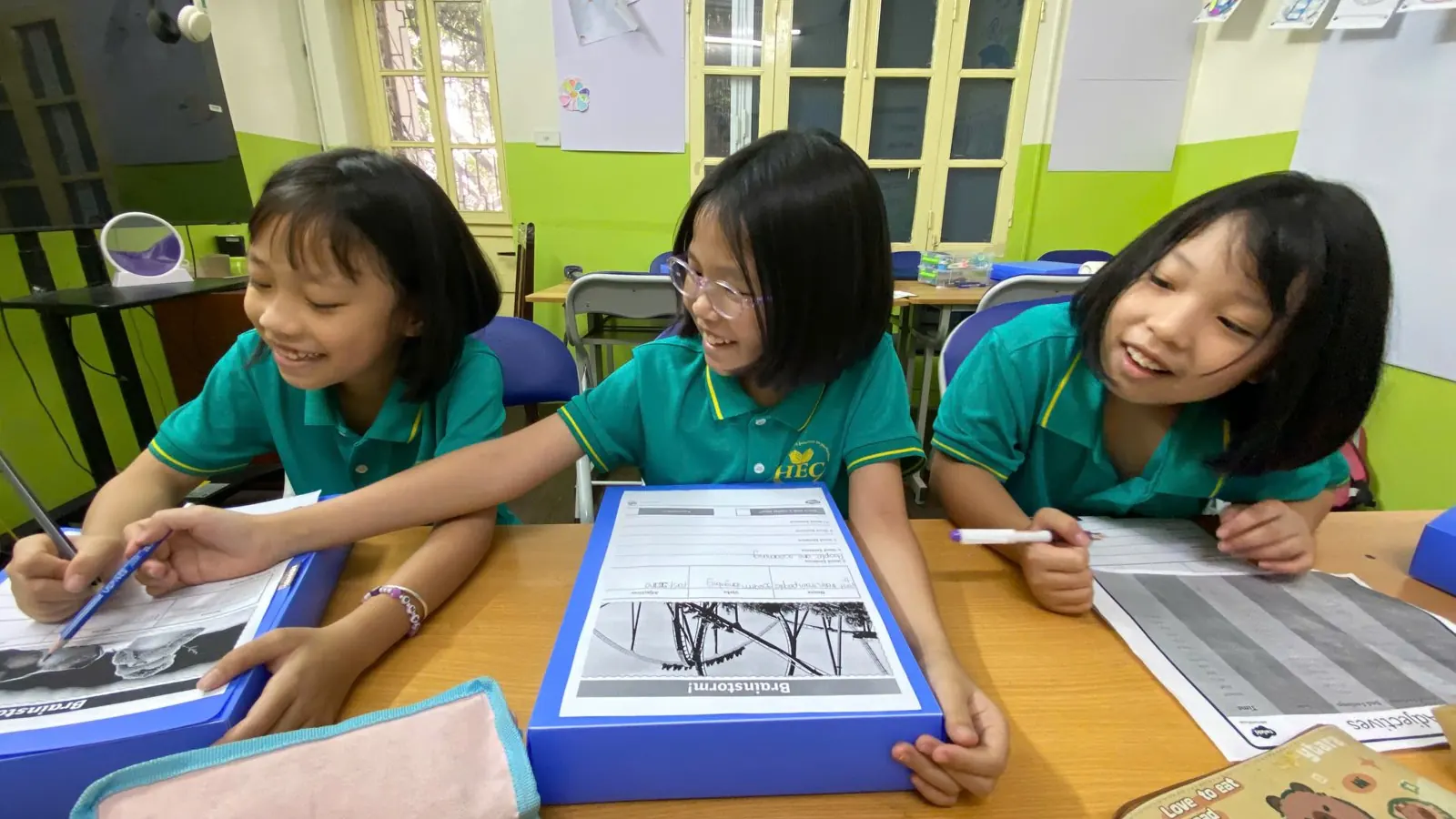
- Between 2025 and 2030, Vietnam is making English compulsory from Grade 1 nationwide (Decision 2371/QĐ-TTg).
- In Hanoi, English is the third subject in the public Grade 10 entrance exam for the 2026–2027 school year (multiple choice, 60 minutes).
- What makes the difference isn't the brand but the program: ESL teaches children words and set phrases; ELA — how American schools teach English — teaches them to use English to read, write, discuss and present.
- Six questions to ask any center: ELA or ESL, maximum class size, who teaches, which standards and goals, how fees are charged, and how progress is measured.
- HEC: an ELA program aligned to the Common Core, a US-certified teacher with foreign and Vietnamese teaching assistants, max 12 students per class, 210,000 VND per session (about 1.68–1.89 million VND a month), billed per session held.
In this article
Why the 2026–2027 school year matters
Whether you're a Vietnamese family or an international family living in Hanoi, three policy changes make the choice of an English program more important this year.
1. English becomes a “second language” in Vietnamese schools
On 27 October 2025, the Prime Minister signed Decision 2371/QĐ-TTg, approving the project “Making English the second language in schools, 2025–2035, with a vision to 2045”. For 2025–2030 it sets two targets:
- every general-education school in Vietnam teaches compulsory English from Grade 1;
- every kindergarten in cities and well-resourced urban areas has the conditions for children to get familiar with English.
In practice, the gap between children who start Grade 1 with some English and those who don't will show up earlier. The sensible goal isn't a race — it's for your child to arrive at Grade 1 confident and used to hearing and speaking English.
2. English is the third subject in Hanoi's Grade 10 exam
For the 2026–2027 public, non-specialized Grade 10 entrance exam, Hanoi chose a foreign language as the third subject, alongside Math and Literature. The language paper is multiple choice, 60 minutes, mostly on the Grade 9 syllabus. The third subject is announced each year, so families with children in Grades 8–9 should watch for the 2027–2028 announcement.
3. The value of international certificates is shifting
In the 2026 high-school graduation exam, students with IELTS 4.0 or above were exempt from the foreign-language paper. For university admission, the 2026 rules cap bonus points for language certificates at 1.5, and a draft for 2027 proposes removing them. We cover this in detail in IELTS classes in Đống Đa: centers, fees and the 2026–2027 rules.
English is moving from “bonus” to core skill. The right investment is helping your child actually use English — reading, writing clearly, speaking with confidence. Exams then take care of themselves.
6 things to check before choosing a center
We suggest asking every center these six questions — with HEC's answers underneath, so you have a benchmark.
1. Does the program teach children to use English (ELA), or just memorize it (ESL)?
It's the deciding question few parents think to ask. An ESL class teaches children about English: word lists, grammar rules, model dialogues. An ELA (English Language Arts) class teaches them to use English the way American students do: reading real texts, writing paragraphs in different genres, discussing and presenting with evidence. Research on how languages are learned favors the second — see What is ELA? ELA vs ESL.
At HEC: an ELA program aligned to the US Common Core, following Cambridge English levels (which match the CEFR).
2. What is the maximum class size — as a number?
Every center says “small classes”. Ask for the number. Simple arithmetic: split evenly, a 90-minute lesson gives each child about 7.5 minutes in a class of 12, but only about 4.5 minutes in a class of 20. For young learners, that's the difference between having pronunciation corrected every lesson and barely at all.
At HEC: no more than 12 students per class, published on every class page.
3. Who actually teaches, and are they a trained teacher?
A native accent is not the same as teaching skill. Ask which teaching qualification the teacher holds, whether they teach your child's class for the whole course, and whether there's a teaching assistant.
At HEC: a US-educated teacher with a teaching degree and a New Jersey (USA) teaching certificate, with foreign and Vietnamese teaching assistants who hold degrees in English or education.
4. Which standards does the program follow, and are the goals measurable?
International textbooks (National Geographic, Oxford, Cambridge) are a good start. Ask too which standards the program follows (Common Core, CEFR, Cambridge) and for a concrete target for each level — for example “reads 70–90 words per minute at 95% accuracy” rather than “makes clear progress”.
At HEC: every level has specific completion criteria published on its class page; the center is licensed by the Hanoi Department of Education and Training.
5. Per session or the whole course upfront? Any hidden fees?
Convert everything to a price per teaching hour, then ask: do you pay the whole course upfront or monthly, what happens if you pause or leave, and are there book or exam fees?
At HEC: 210,000 VND per 90-minute session, billed for the sessions held each month, nothing paid upfront, and no book fee at present.
6. How will you know your child is progressing?
Ask about entry and exit assessments, regular reports and your child's actual work — writing, presentations, videos. A center confident in its teaching will let you sit in on a class.
At HEC: monthly progress reports, Zalo updates, open classroom visits — and real, unscripted lesson videos at the end of this article.
Watch any 10 minutes and count: how many times does your child speak? Are they called by name, corrected, asked “why”? That number tells you more than any brochure.
ELA or ESL? English program types for kids in Hanoi, compared
Rather than compare brand names, compare models. Most families in Đống Đa, Cầu Giấy or Thanh Xuân end up choosing between the five options below. The HEC column is what we publish and you can check in class; the other columns describe common models, not any specific center.
| Aspect | HEC (ELA, small classes) | Conversation-English center (ESL) | Large branded chain | Home tutor | Apps & online courses |
|---|---|---|---|---|---|
| Program | ELA aligned to the Common Core; Cambridge levels (matching the CEFR) | Topic-based conversation: vocabulary, set phrases | One standardized curriculum across the chain | Depends on the tutor; often follows the school textbook | Vocabulary, pronunciation, short exercises |
| Who teaches | A US-certified teacher, with foreign and Vietnamese teaching assistants | Varies; ask who teaches the whole course | Varies by campus and class | One person; very mixed qualifications | No live teacher |
| Class size | Max 12, published | Many don't publish a number | Often just “small classes” | One-to-one or a small group | Not applicable |
| What children do in class | Read real texts, write paragraphs, debate, present | Learn words, practice phrases, play games | Depends on the program | Often worksheets and test practice | Individual exercises on a screen |
| Fees | 210,000 VND per session, published, billed per session held | Often quoted in consultation, paid per course | Often unpublished; paid per course or in installments | Per hour, negotiated | Subscription, low cost |
| Tracking progress | Measurable criteria, monthly reports, open classroom visits | Varies — ask for specifics | Usually periodic tests | Depends on the tutor | In-app scores |
← Swipe to see the full table →
The columns other than HEC describe common models in the market, not any particular center; each one may differ. Use the six questions above to ask directly.
Happy English Club (HEC): a small-class ELA center in Đống Đa
No. 25, Alley 242 Láng Street, Đống Đa Ward, Hanoi · Zalo 0975 679 889
- An ELA program aligned to the US Common Core, following Cambridge English levels (matching the CEFR); National Geographic and Oxford textbooks.
- A teacher with a New Jersey (USA) teaching certificate, supported by foreign and Vietnamese teaching assistants with degrees in English or education.
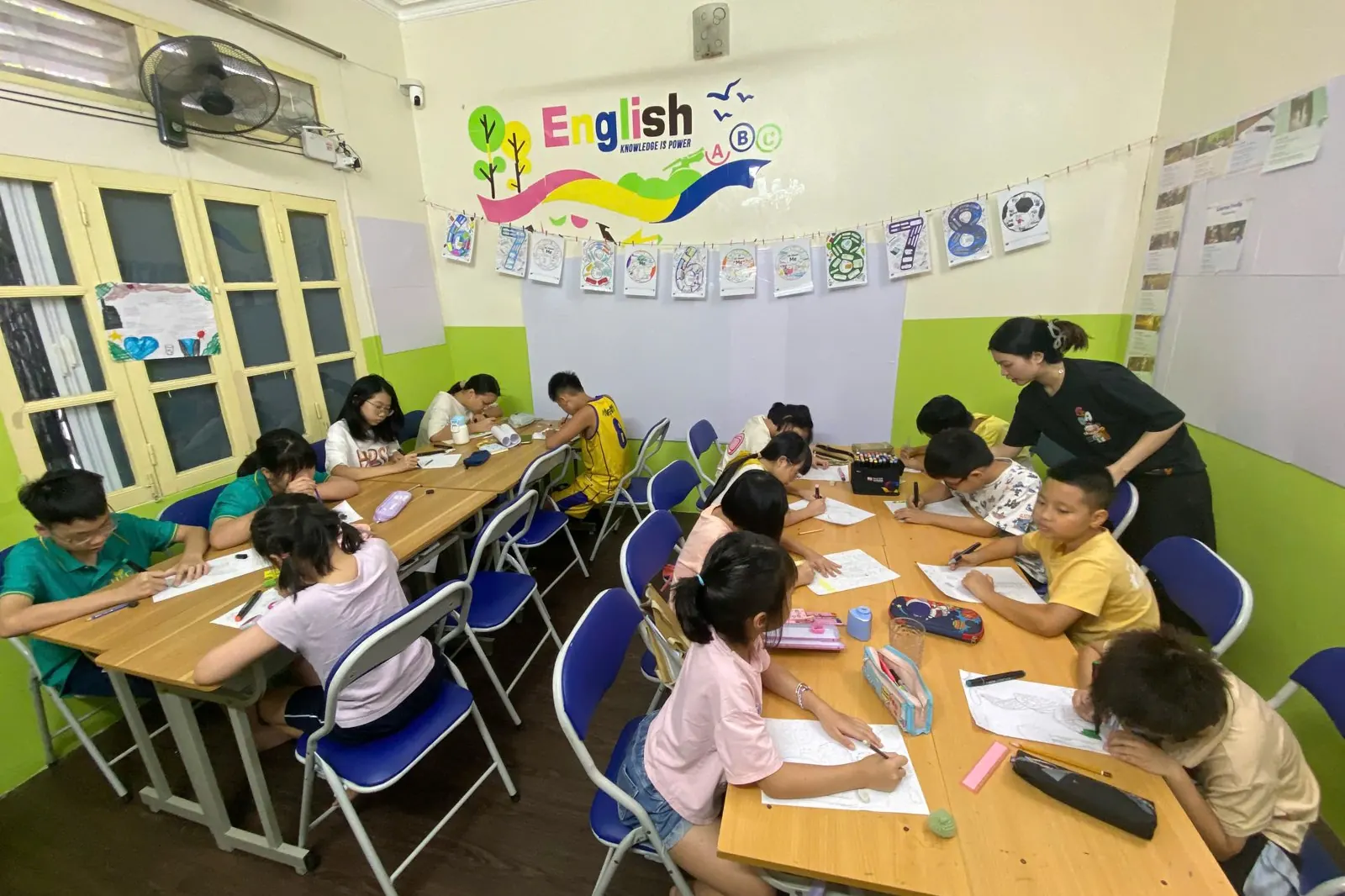
- No more than 12 students per class, two 90-minute sessions a week; licensed by the Hanoi Department of Education and Training.
- Advanced ELA classes for high achievers: Jupiter (Grades 3–4) and SKY 1 (Grades 5–6, with Grade 6 entrance and KET/PET preparation).
- Fees published per session, billed per session held; free Saturday Reading Club.
A good fit if: you want your child to use English to read, write and present — not just memorize words — in a class small enough for the teacher to know every child.
Which HEC class fits your child?
| If your child… | Class |
|---|---|
| Is in kindergarten (4–6) and just starting English | Mars |
| Is learning to sound out words and read short sentences | Venus |
| Reads short passages and is starting to write paragraphs | Neptune |
| Is in Grades 3–4, already strong in English and wants a challenge | Jupiter (advanced ELA) |
| Is in Grades 5–6, strong in English, preparing for Grade 6 entrance or KET/PET | SKY 1 (advanced ELA) |
| Is in Grade 6 and needs solid academic writing | Sanrio Grade 6 |
| Wants to learn math in English | Mercury |
| Is in secondary school and aiming for IELTS | Sun |
Not sure where your child fits? The free placement test will tell you — and we'll say so plainly if your child needs to strengthen the foundations first.
An English roadmap by age: kindergarten to Grade 12
Every child starts from a different place, so ages are only a guide. At HEC, children are placed by level with a free placement test.
Kindergarten (ages 4–6): listen, imitate, enjoy
At this age the goal is sound and enthusiasm: songs, picture books and games; getting to know letters and sounds; short sentences about themselves. Don't measure grammar. Measure whether your child wants to speak English.
Watch some of HEC's youngest learners at Summer Camp 2026 — Elsa, Rainbow and Elina:
Grades 1–2 (ages 6–8): phonics and reading aloud
This is the phonics stage: blending sounds, high-frequency words, reading short sentences aloud. With English now compulsory from Grade 1, children who already connect sounds to letters walk into class with far more confidence.
Grades 3–5 (ages 8–11): fluent reading, paragraphs, presentations
Children move from learning to read to reading to learn: informational texts, paragraphs with a topic sentence, short presentations. It's also a great age for debate and project work. For children who are already strong in English, this is the moment to move fully into ELA: HEC runs Jupiter for Grades 3–4 and SKY 1 for Grades 5–6.
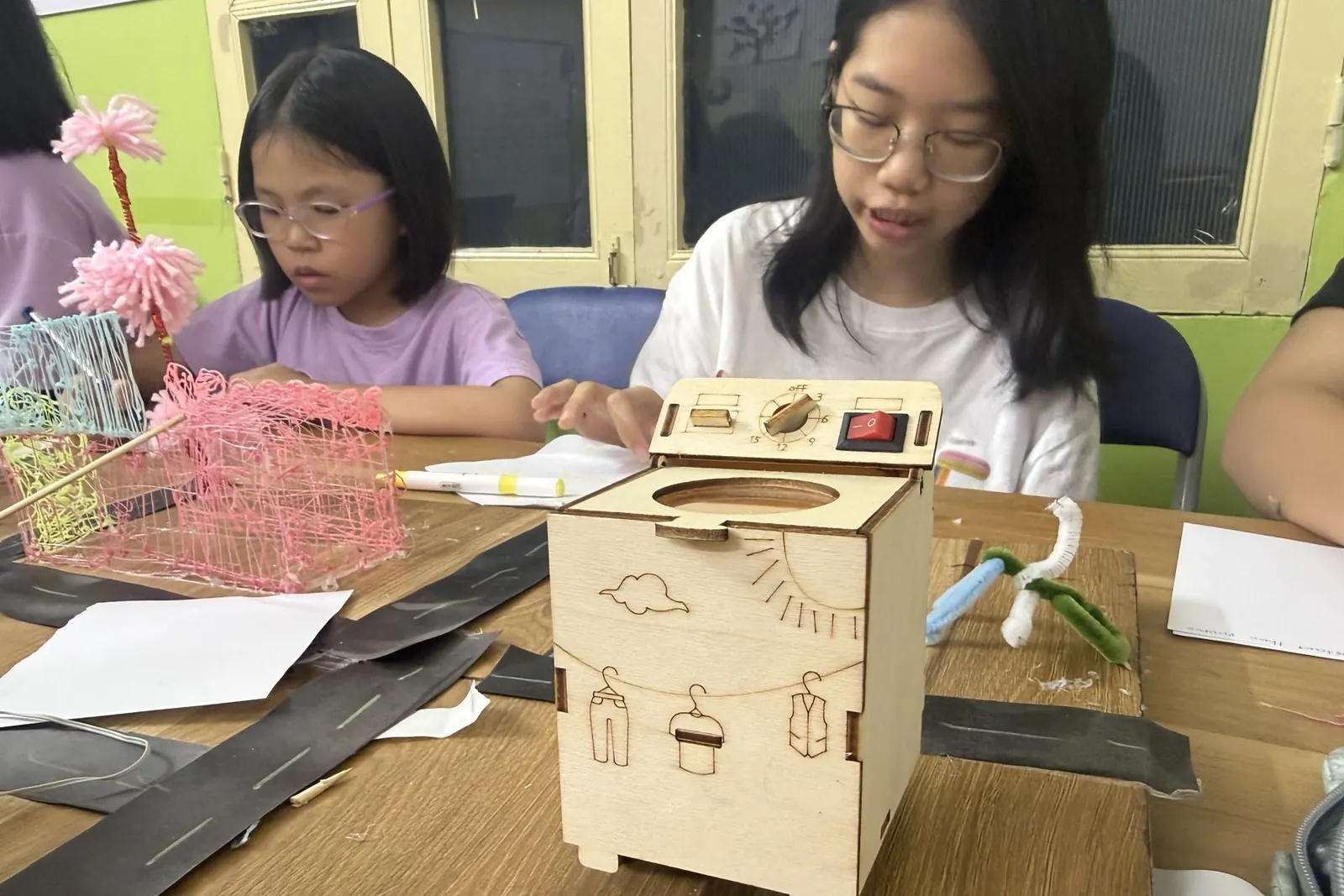
Grades 6–9 (ages 11–15): academic grammar and the Grade 10 exam
The focus shifts to controlling tenses and sentence structure, multi-paragraph writing with a clear argument, and reading longer texts. For Hanoi students, Grade 9 is also the year of the Grade 10 entrance exam — for 2026–2027, a foreign language is one of its three subjects.
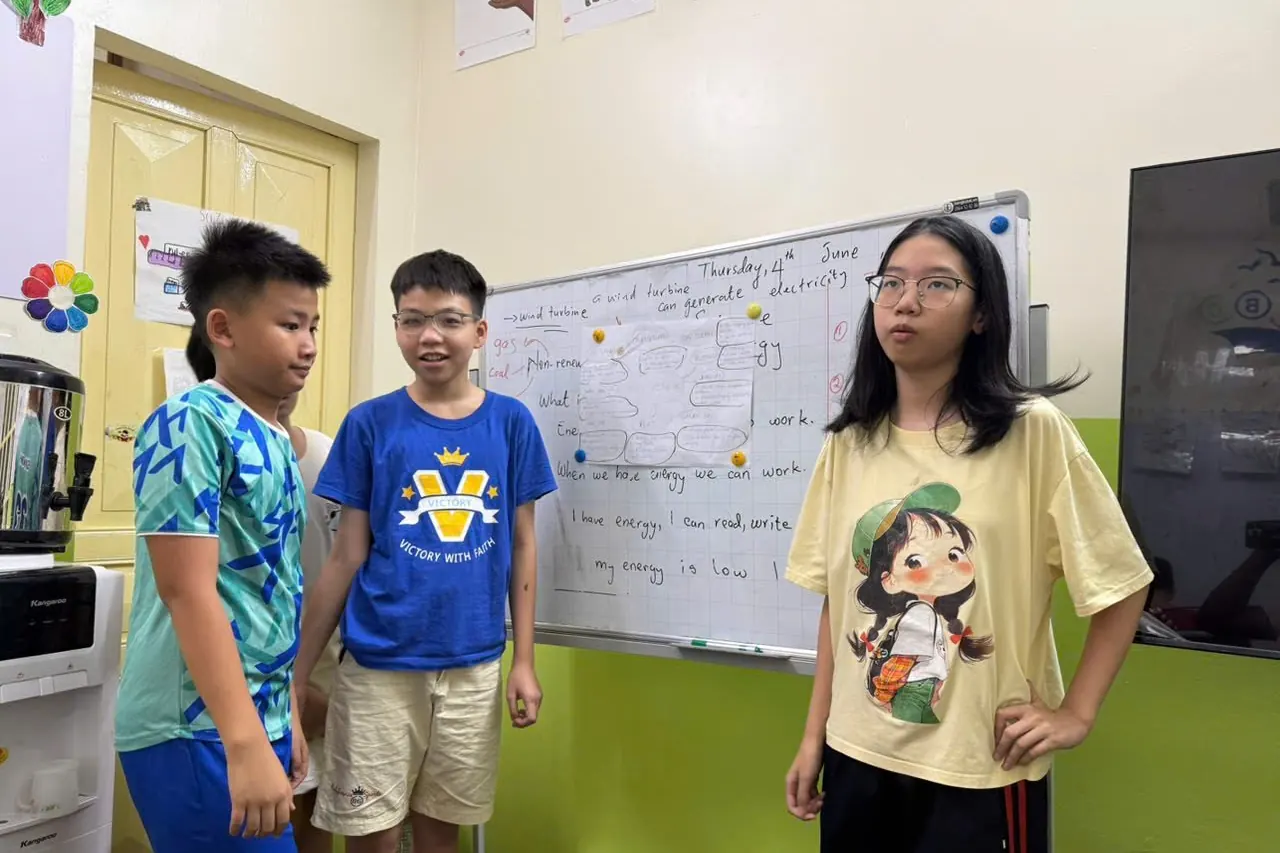
Grades 10–12 (ages 15–18): academic English and IELTS
This is the right stage for structured IELTS preparation: essay writing, extended speaking, academic reading and timed exam strategy. See the full roadmap and fees in IELTS classes in Đống Đa.
HEC levels and their measurable targets
Each HEC level has published completion criteria:
- Mars · National Geographic Look Starter
Decodes CVC words with at least 90% accuracy; reads aloud at 30–40 words per minute; speaks 6–8 sentences about self and family; writes 4 correct sentences with capitals and spacing. - Venus · National Geographic Look 1
Reads 70–90 words per minute at 95%+ accuracy; writes a 4–6 sentence paragraph with correct punctuation; speaks for 1–2 minutes from picture cues. - Neptune · National Geographic Look 2
No more than 3 past-tense errors per 100 words; answers who/what/why with evidence; writes a cohesive paragraph with topic and closing sentences. - Jupiter · ELA Grades 3–4, advanced · National Geographic Reach Higher
Reads 120–150 words per minute at 90%+ accuracy; writes 8–10 sentence paragraphs in three genres; gives a clearly structured 2-minute poster talk. - SKY 1 · ELA Grades 5–6, advanced · Oxford Discover
Summarizes a ~300-word article into 5–6 bullet notes; presents for 3 minutes; writes a report with a clear introduction, body and conclusion; prepares for Grade 6 entrance and KET/PET. - Sanrio Grade 6 · Grammar & Writing G6
85%+ grammar accuracy in edits; 2–3 paragraphs (180–220 words) with a thesis and support; a 2-minute evidence-based speech. - Sun · IELTS
Target band 5.5–7.0; Task 2 of 250+ words in 40 minutes; sustains a coherent 3–4 minute speaking interview.
There's also Mercury, Cambridge Math taught in English, for students who want math reasoning and math vocabulary together.
What English classes for kids cost per month
It's the question parents ask most — and the information many centers don't publish. HEC publishes it: 210,000 VND per 90-minute session. Standard classes meet twice a week (3 hours a week), so about 8–9 sessions a month.
| Sessions in the month | Standard class fee |
|---|---|
| 8 sessions (a month with a holiday) | 1,680,000 VND |
| 9 sessions | 1,890,000 VND |
| Per teaching hour | 140,000 VND |
- Billed for sessions actually held each month — no upfront course fee, no hidden costs.
- 5% sibling discount.
- No book fees at present.
- Placement test and trial class: free.
- Saturday Reading Club (14:00–16:00): free, all ages.
- Convert to a price per teaching hour (total fee ÷ total hours).
- Add book, exam and materials fees, if any.
- Ask how far ahead you pay and what the pause/refund policy is.
- Then put the cost next to the class size: at the same price, a class of 12 and a class of 20 are different experiences.
Proof, not promises: real HEC ELA classes
We think parents should be able to see how their children learn, not just read slogans. These videos were filmed in class — no script, no staging.
Grade 4 students debate in English
An ordinary lesson: students take a position, listen to the other side and respond — entirely in English. This is what “students talk more than the teacher” really looks like.
Campers talk about Summer 2026
HEC's 2026 summer camp had 21 students. At the end, every family received a private journal page: a highlight film, a curated photo gallery, the child's own reflection video and a bilingual written assessment from the teacher. See more on the HEC Summer Camp 2026 page.
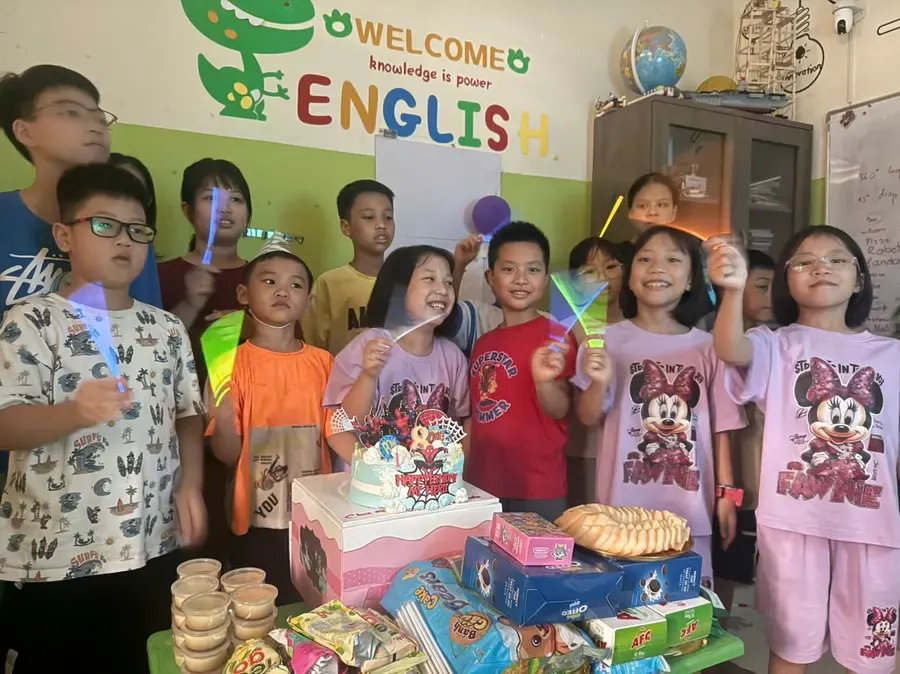
Book a free trial class
A short placement test, one real lesson, and you count how often your child speaks. No commitment, no pressure.
Message on Zalo: 0975 679 889 Call usFrequently asked questions
What age should my child start English classes at a center?
There is no single ideal age. For 4–5-year-olds the goal is listening, imitating and enjoying English, not grammar. HEC takes students from age 4 to Grade 12 and places them by level with a free placement test.
What is the difference between ELA and ESL, and which is better for my child?
ESL teaches English as a foreign language: topic vocabulary, grammar and conversation patterns. ELA (English Language Arts) is how American schools teach English: reading real texts, writing in different genres, discussing and presenting with evidence. If you want your child to use English to learn and think, not just memorize words, ELA is the stronger foundation. HEC teaches the ELA way, aligned to the Common Core.
How many English classes a week are enough?
Consistency matters more than volume. HEC's standard classes meet twice a week for 90 minutes (3 hours a week), combined with reading at home and the free Saturday Reading Club.
How much do English classes for kids cost in Hanoi per month?
Fees vary and many centers do not publish them. At HEC it is 210,000 VND per 90-minute session; at two sessions a week (8–9 per month) that is about 1,680,000–1,890,000 VND a month, billed only for sessions actually held.
Should I choose a foreign teacher or a Vietnamese teacher?
You don't have to choose one. Nationality does not determine teaching quality; what matters is whether the teacher holds a teaching degree or certificate, teaches your child's class consistently, and has a teaching assistant. At HEC, classes are led by a teacher with a New Jersey (USA) teaching certificate, supported by foreign and Vietnamese teaching assistants with degrees in English or education.
Does a small class really make a difference?
Yes. Split evenly, a 90-minute lesson gives each child about 7.5 minutes in a class of 12, but only about 4.5 minutes in a class of 20. Small classes also mean pronunciation and writing get corrected more often.
How can I tell whether my child is making progress?
Ask for measurable targets for each level, regular reports and permission to observe a class. HEC sends monthly progress reports, updates parents on Zalo and welcomes classroom visits.
Where is Happy English Club and when are classes held?
HEC is at No. 25, Alley 242 Láng Street, Đống Đa Ward (formerly Thịnh Quang Ward, Đống Đa District), Hanoi. Classes run on weekday evenings and weekends; message 0975 679 889 on Zalo for the current timetable.
Sources
- Thư Viện Pháp Luật — Decision 2371: roadmap for making English the second language in schools (29 Oct 2025, in Vietnamese).
- Nhân Dân — Hanoi picks a foreign language as the third Grade 10 exam subject for 2026–2027 (29 Jan 2026, in Vietnamese).
- VnExpress — 2026 university admission rules tighten IELTS bonus points (15 Feb 2026, in Vietnamese).
- Happy English Club — What is ELA? ELA vs ESL (seven research findings on how languages are learned, with sources).
- Happy English Club — program pages and fees.